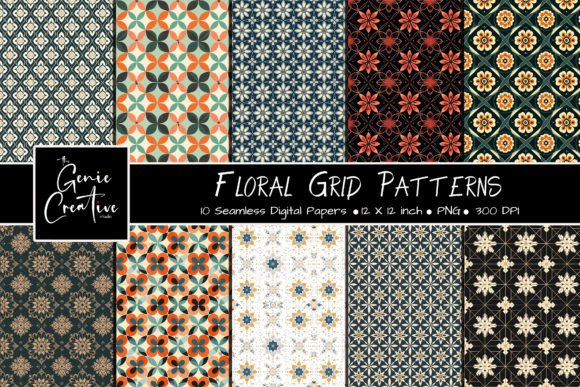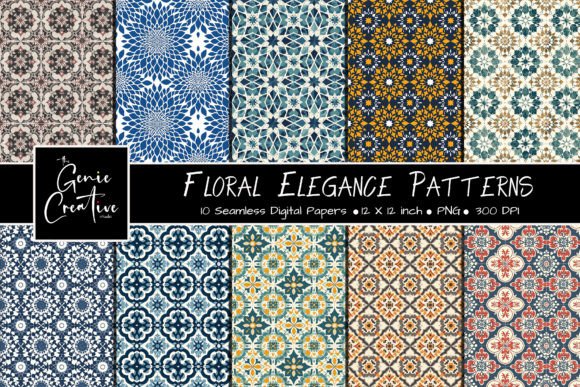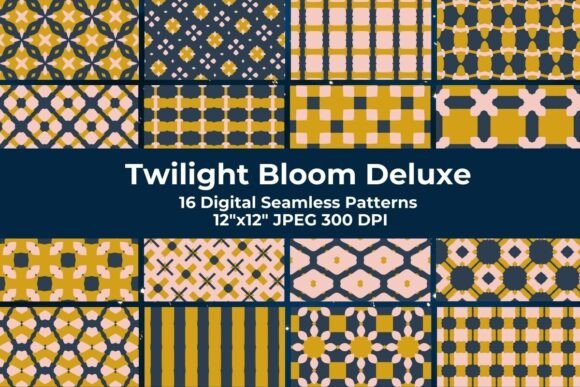
Seamless Floral Patterns and Flowers Pattern: A Comprehensive Guide to Selection and Application
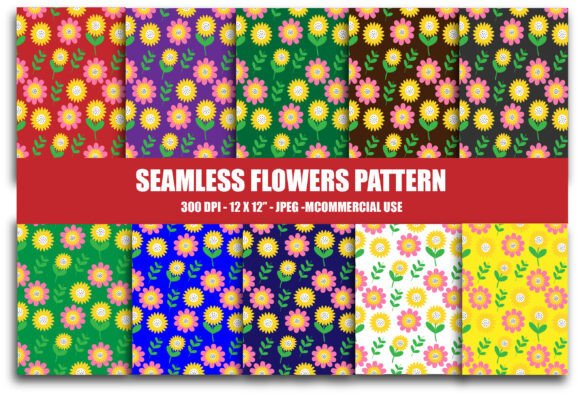
In the realm of digital design and textile arts, few elements are as versatile or enduring as floral motifs. However, the specific implementation of these designs often determines their success in a final product. This is where Seamless Floral Patterns become critical. Unlike standard images that simply depict flowers, a seamless pattern is engineered to repeat infinitely without visible breaks, creating a continuous field of imagery. When combined with high-resolution specifications like those found in a collection offering 10 Files JPEG - 300 DPI - High Resolution - 12 x 12, these assets transform from simple graphics into professional-grade tools for commercial and personal projects.
Understanding the distinction between a generic flower image and a true Seamless Flowers Pattern is the first step in making an informed decision. The technical requirement for seamlessness involves precise alignment at the edges, ensuring that when tiled, the visual flow remains uninterrupted. This characteristic is non-negotiable for applications ranging from fabric printing to web backgrounds. For professionals evaluating resources, the availability of a curated set—such as a pack containing ten distinct variations—offers significant advantages over purchasing single-use images individually.
Distinguishing Seamless Floral Patterns from Standard Imagery
The primary differentiator lies in the workflow efficiency and the final aesthetic quality. A standard photograph or illustration of a bouquet, while beautiful, cannot be tiled across a large surface without creating obvious grid lines or disjointed clusters. In contrast, a Flowers Pattern designed for tiling utilizes mathematical precision to align the top edge with the bottom and the left with the right. This allows designers to fill any amount of space, whether it is a small mobile screen or a roll of fabric, without losing visual integrity.
When examining a collection described as High Resolution - 12 x 12, one must consider the implications of the physical dimensions. A 12x12 inch file at 300 DPI provides a resolution of 3600 pixels on each side. This level of detail is substantial. It ensures that even if the pattern is scaled up significantly for large-format printing, such as wall murals or banner displays, the individual petals and leaves retain their sharpness. Lower resolution files often result in pixelation or blurriness when stretched, rendering them unsuitable for print media. Therefore, the Seamless Floral Patterns in this category are not merely decorative; they are functional assets built for scalability.
Evaluating Format and File Specifications
The choice of file format plays a pivotal role in how these patterns are utilized. The specification of 10 Files JPEG indicates a balance between compatibility and file size. JPEGs are universally supported by almost every design software, web platform, and printing service. They offer a practical solution for users who need to quickly import assets without worrying about proprietary formats or complex layer structures.
However, the tradeoff exists in the lossy compression inherent to JPEGs. While modern compression algorithms are sophisticated, repeated saving can degrade quality. For users requiring absolute fidelity in color gradients or transparent backgrounds, a TIFF or PNG might be theoretically superior. Yet, for the vast majority of use cases involving Seamless Flowers Pattern applications—particularly in web design, social media graphics, and general print layouts—the JPEG format provides sufficient quality with manageable file sizes. The inclusion of 300 DPI confirms that these files are optimized for print, adhering to industry standards for offset and digital printing processes.
Consider the scenario of a boutique clothing brand launching a new summer line. They require a background texture for their website and a print-ready file for their packaging. A set of Seamless Floral Patterns offers immediate utility. The designer can apply the same asset to the website header and the garment tags, maintaining brand consistency. If the files were only available in low-resolution web formats, the brand would face a dilemma: use blurry images online or purchase separate high-resolution files for packaging. The 12 x 12 dimension further simplifies this, as it represents a standard square unit often used in scrapbooking and quilting, bridging the gap between digital and physical crafting.
Comparing Commercial Versus Personal Utility
p>The label Commercial Use Personal Use is a crucial factor for creators navigating legal and ethical boundaries. Many online resources restrict usage to personal projects only, meaning a user cannot sell products featuring the design. A license that explicitly permits both expands the potential of the Flowers Pattern significantly.For the hobbyist, the value proposition is straightforward: access to high-quality, ready-to-use designs for greeting cards, home decor, or personal blogs without the need to create art from scratch. The ability to download ten distinct variations means there is enough variety to keep a project fresh without overwhelming the creator. For the commercial entity, the stakes are higher. Using a pattern without proper licensing can lead to legal repercussions. Therefore, confirming that the Seamless Floral Patterns include commercial rights is essential for businesses producing mugs, tote bags, wallpapers, or textiles.
When comparing this type of pre-made asset to hiring a custom illustrator, the differences in cost and time are stark. Custom work offers unique IP ownership but requires weeks of communication, sketching, and revision. A pack of High Resolution patterns provides instant gratification. The tradeoff is uniqueness; since the patterns are sold to multiple parties, they may appear on various products simultaneously. For brands seeking mass appeal or quick turnaround times, the Seamless Flowers Pattern approach is often the most pragmatic choice. However, for luxury brands requiring exclusive branding, a custom commission might still be necessary despite the higher investment.
Strategic Decision Factors for Designers
Selecting the right resource involves analyzing specific project requirements against the capabilities of the asset. The 10 Files aspect suggests a thematic collection. Typically, such sets will vary in density, color palette, and style—from delicate watercolor blooms to bold, graphic florals. This variety allows for a cohesive yet dynamic design system.
One must evaluate the complexity of the pattern relative to the intended medium. Dense, intricate Seamless Floral Patterns can look stunning on a large canvas but may lose definition when reduced to a thumbnail icon. Conversely, sparse patterns might appear empty on a large fabric print. The 12 x 12 size is a sweet spot for many applications, providing enough data points to see the full repetition cycle while remaining compact enough for easy management. Users should test the tileability by duplicating the image horizontally and vertically to ensure no seams are visible before committing to a production run.
Another consideration is the color mode. While not always specified in basic descriptions, high-quality print assets should ideally be in CMYK, whereas digital assets are typically RGB. Most JPEG downloads default to RGB. If the end goal is professional offset printing, the user must verify if the colors can be safely converted to CMYK without shifting the vibrancy of the Flowers Pattern. For screen-based work, RGB is the correct choice and will render more vividly on monitors.
Identifying Limitations and Alternatives
No single solution fits every scenario. The limitations of a pre-packaged Seamless Floral Patterns set primarily revolve around customization. Once downloaded, the colors and composition are fixed. If a designer needs a specific shade of blue or a larger bloom size, editing a JPEG is possible but often results in a loss of quality or an unnatural look. Vector-based alternatives, such as SVG or EPS files, offer infinite scalability and editability, allowing for color changes without pixelation. However, vector files are often more expensive and require advanced software skills to manipulate effectively.
Furthermore, the "seamless" nature of the pattern implies a repetitive structure. In some avant-garde design contexts, this repetition can feel predictable or dated. Modern trends sometimes favor organic, non-repeating layouts that mimic natural growth rather than geometric tiling. In such cases, a Flowers Pattern might feel too rigid. Designers should weigh the desire for a classic, textured background against the need for a unique, editorial layout.
Additionally, the 10 Files constraint means the user is limited to ten variations. If a project requires fifty different textures, relying solely on this pack would necessitate purchasing additional assets. In contrast, subscription services offer unlimited access to thousands of patterns, though often with lower individual file quality or less specific curation. The choice between a targeted, high-quality pack and a broad, subscription-based library depends entirely on the volume and specificity of the user's needs.
Making the Final Choice
The decision to utilize a set of Seamless Floral Patterns ultimately rests on the balance between budget, timeline, and quality requirements. For professionals needing reliable, high-resolution assets for immediate deployment, a pack offering 10 Files JPEG - 300 DPI - High Resolution - 12 x 12 with Commercial Use Personal Use rights represents a robust solution. It eliminates the technical hurdles of creating seamless repeats and ensures print readiness.
Conversely, if the project demands extreme customization, exclusivity, or vector manipulation, the user may find themselves better served by investing in custom illustration or vector libraries. There is no single "best" option; rather, the right choice is the one that aligns with the specific constraints of the creative brief. By understanding the strengths of seamless technology and the limitations of raster formats, designers can confidently select the resources that elevate their work without compromising on quality or legality.
Whether applied to a digital wallpaper, a textile print, or a marketing campaign, the Seamless Flowers Pattern serves as a foundational element of visual storytelling. Its ability to provide consistent, high-quality texture makes it an indispensable tool in the modern designer's arsenal. As long as the user respects the technical specifications and licensing terms, these patterns offer a pathway to professional results with minimal friction.